
Cloud House: The Pink Postmodern Love Letter That London Argued About
By Dakota Jones
LD3 News Desk: Fashion, Design & Architecture
London has seen a lot of things. It has seen buildings that look like they were designed by committee, buildings that look like they were designed by accountants, and buildings that make people stop on the sidewalk and say, “Well, that’s certainly pink.”
Cloud House, in Gospel Oak, north London, is the third kind.
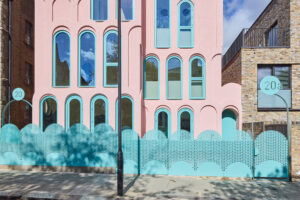
Architect Peter Morris has completed a pair of offset semi-detached homes near Hampstead Heath. One is for Morris and his partner, producer Emily Kennedy. The other belongs to a neighbor. The exterior is pale marshmallow pink, trimmed in turquoise, and framed by decorative arches. It is not trying to blend in. London noticed.
The project was featured on Grand Designs in September 2026, then spread across social media, where reactions reportedly landed at two extremes. Morris described them as “overwhelmingly positive or overwhelmingly negative, with nothing in between.” Ah, the internet: still allergic to a measured response.
A love letter, with arches
Morris and Kennedy drew inspiration from their honeymoon in Miami, where they admired the city’s Art Deco architecture and its pink-and-turquoise palette. Morris called the house “an architectural love letter to my wife.” That is a charming sentence. It is also a rather more substantial gift than a postcard.
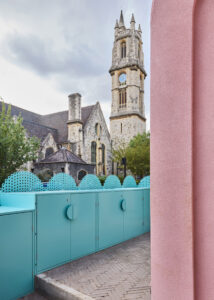
The design has a local conversation going, too. The homes sit beside St Martin’s Hall, whose Grade II-listed school frontage reportedly resembles a medieval castle, and across from Grade I-listed St Martin’s Church. Historian Nikolaus Pevsner called the church “the craziest of London’s Victorian churches.” Its brightly colored chancel ceiling and dramatic wooden nave arches offered plenty of precedent for a neighborhood that was already not exactly whispering.
Dezeen dubbed Cloud House “fairytale flamboyance.” That’s apt. The result doesn’t copy its historic neighbors, but it does answer their curves and theatricality with a contemporary, candy-floss-colored reply.
What’s holding up the pink?
The decoration may look like confectionery. The structure is more conventional: steel and blockwork, clad in lightweight polystyrene. The material is cost-effective, adds insulation, and can be molded into curves. The arches were made from polystyrene, sprayed with a waterproof layer and a textured top coat. Morris positioned them himself.
That detail matters. These are not simply graphic flourishes painted onto a flat facade. They give the exterior depth and shadow, and help the house register from the street as a series of sculpted forms. Pink is doing the first impression. The construction is doing the work.
Two homes, two different ideas of home
The project replaced a worn Victorian house where Morris and Kennedy had lived since 2016. From the initial effort to completion, the process took about ten years, including planning with Camden Council. Apparently even a house this cheerful must negotiate the paperwork.
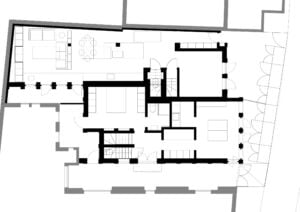
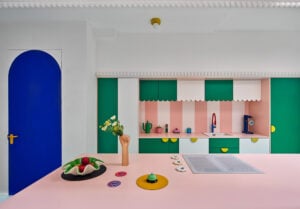
Morris’s home is the smaller one, at 133 square meters. Its ground floor is open plan, with a lounge, kitchen and studio. Bedrooms and bathrooms occupy the upper floors, and the roof terrace includes an outdoor bathtub. Inside, the exuberance keeps going: turquoise epoxy floors, color-drenched bathrooms and an emerald-green striped kitchen.
The neighbor’s home is 165 square meters, with an upside-down layout: its social spaces sit on the top floor beside a terrace. The neighbor’s interiors were left blank for customization. So the shared exterior makes a bold statement, while the two households can decide how loudly they want to answer indoors.
Why London is still arguing
Cloud House raises a question bigger than whether you personally enjoy pink arches: should a new building try to disappear into its street, or can it contribute a distinct voice?
Morris’s case is that color and pattern can create an emotional response that restrained modernism may not. He wanted to “make a beautiful building which I hoped might create a little moment of joy for anyone walking past it on the street.” You don’t have to love the result to understand the ambition.
And that’s the useful distinction. A building can be unusual without being careless. Here, the forms have a relationship to the neighboring church and school, while the colors connect to a specific personal story. The design doesn’t ask everyone to agree. Judging by the comments, it didn’t need to.
For more reporting from the LD3 News Desk, visit our news page.
FAQ
Where is Cloud House?
In Gospel Oak, north London, near Hampstead Heath.
Who designed it?
Architect Peter Morris designed the two homes, one for himself and Emily Kennedy and one for a neighbor.
What are the arches made of?
Polystyrene with a waterproof layer and textured top coat, attached to a steel-and-blockwork structure.
Why is it pink and turquoise?
The palette takes inspiration from the couple’s Miami honeymoon and the city’s Art Deco architecture.
Final Thoughts
Cloud House is not a compromise with the street. It is a bright, deliberately personal addition to a north London setting already rich with eccentric architecture. Some passersby will love it. Some will not. Morris seems prepared for both outcomes, and London, as ever, has opinions.
Sources: